Allergen Questions Don't Rotate: Food Safety When a Festival Menu Changes by the Hour
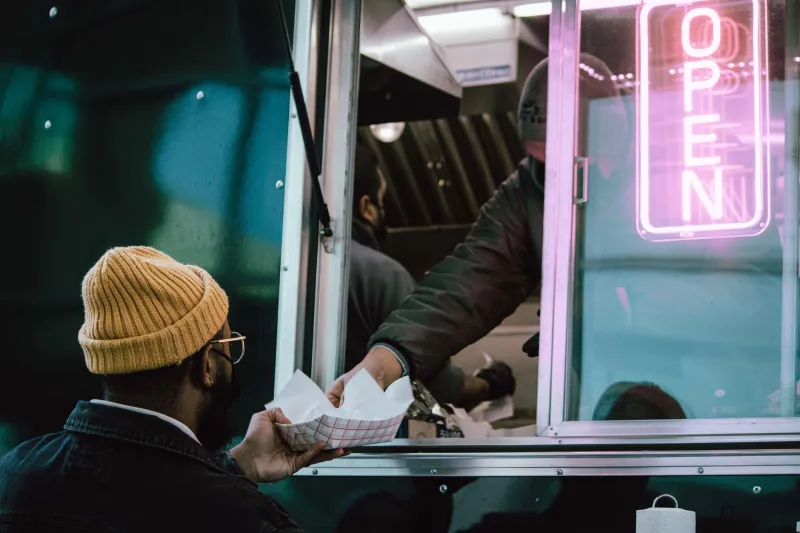
You get about six seconds at the service window. In that window of time you have to find out whether the fryer oil is shared, whether the house sauce hides sesame, and whether the person holding the tongs actually knows. That is the entire conversation, and at a food festival it is being had thousands of times a day by people who are hungry, distracted, and standing in the sun.
Restaurant allergen protocols assume a stable menu and a trained, retained staff. Festival protocols have to survive a menu that gets trimmed for a two-day run, rewritten in marker when a shipment doesn't arrive, and staffed by a mix of owners, seasonal hires, and volunteers who signed up last week. Allergen safety on the festival lot isn't really a menu problem. It's a handoff problem — information moving from a commissary kitchen to a trailer to a cashier to a customer, with a new link inserted every time a vendor rotates in.
The Baseline Is Nine, Not Eight
The federal major allergens are milk, eggs, fish, crustacean shellfish, tree nuts, peanuts, wheat, soybeans, and — since the FASTER Act took effect on January 1, 2023 — sesame. That last one is the one still catching people out, because sesame shows up in tahini, in some flatbreads, in spice blends, and in plenty of sauces that don't advertise it.
The FDA Food Code asks food establishments to notify customers about major allergens in unpackaged food, and many state and local health departments fold a version of that requirement into festival and temporary-event permits. What that looks like on the ground varies wildly: sometimes a laminated sheet, sometimes a checkbox on the application, sometimes nothing at all.
The Menu Board Is the Least Reliable Document on the Lot
A printed board is accurate the moment it's printed. A chalkboard is accurate until someone rubs out the line for the item they sold out of at 1 p.m. A QR code is accurate only if the vendor has signal and a page that still exists on Sunday.
What holds up better is boring: a laminated ingredient binder clipped inside the window, one page per menu item, with a date on the cover and a plain-language line about shared equipment. Prepared in a kitchen that also handles peanuts, tree nuts, wheat, milk, and sesame. That single sentence does more work than a dozen asterisks, because cross-contact — not the ingredient list — is the risk most attendees are actually asking about.
Who Is Actually Answering the Question
Most festival vendors run a lean shift. The owner works the register during the rush, and the person at the window is whoever was available. That's the reality, and pretending otherwise is how a confident guess turns into a bad afternoon.
Three things separate the vendors who handle this well:
- A named allergen contact per shift. One person who can read the label, find the binder, and answer without guessing. Everyone else knows to go get that person.
- A pre-shift huddle that takes ninety seconds. Not a training module — a huddle. This is the fryer item. This one has sesame. If someone asks and you don't know, say so and grab me.
- A scripted honest answer. 'I don't know, let me get someone who does' is a good answer. 'It should be fine' is the answer that causes problems.
ServSafe Allergens and similar programs are worth the two hours, but a certificate is not a substitute for the huddle. Training decays fast when the roster churns.
Cross-Contact Is Where Festivals Get Weird
Shared fryers are the classic: fries and breaded shrimp in the same oil, or a dedicated 'gluten-free' item dropped in with everything else. Less obvious are the shared flat-top, the same tongs crossing between two proteins, gloves that get wiped instead of changed, a self-serve condiment bar with one ladle doing four jobs, and the cutting board that hasn't been swapped since setup.
The fixes are cheap and unglamorous. Foil on a corner of the flat-top. A second fryer basket, marked. Squeeze bottles instead of shared ladles. Pre-wrapped portions at the condiment table. A roll of blue tape and a marker to label which tongs belong to which station.
What Event Planners Should Demand Before the Gates Open
None of this lands on the vendor alone. The organizer sets the standard, and the standard needs to exist two weeks out, not at 7 a.m. on load-in day.
- Collect an ingredient sheet per menu item with the vendor application — one fixed template, no freeform email attachments. Ask specifically about gluten, sesame, peanuts, tree nuts, shellfish, and dairy.
- Publish it. Put the allergen columns in the public vendor list, the same way you list booth numbers. Attendees who plan ahead will do the work for you.
- Require a reachable allergen contact — a cell number logged by the organizer and a radio call sign if you're running radios.
- Hold a fifteen-minute vendor meeting on load-in morning that covers allergens, handwashing, and where medical is staged.
- Staff an information tent with printed binders for vendors who meant to submit paperwork and didn't.
- Discourage vague claims. 'Gluten-friendly' and 'allergy-safe' are marketing, not information. If a vendor can't verify a claim, they shouldn't make it.
The Six-Second Script
For attendees, a little preparation beats a lot of trust.
- Check the window before you get to it. If there's no ingredient information visible, that's information too.
- Ask specific questions. Not is this safe — ask is the chicken fried in the same oil as the shrimp or does the sauce have sesame or tahini.
- Ask the person who can read the label, and don't be shy about waiting for them.
- Treat cross-contact as the main event. Most people asking at a festival already know what's in the food; they don't know what it touched.
- Carry your epinephrine if it's prescribed, and take thirty seconds at the gate to locate the medical tent. Tell the people you came with.
A festival can't make a menu static, and it shouldn't try. What it can do is make the answer reliable — printed, dated, and attached to a person who knows. That's a handoff worth designing.